Thursday, November 28, 2013

Rubber

The sheriff in Rubber makes it abundantly clear early on in the film that many things happen in movies for "no reason". Whether it's the color of E.T.'s skin, or how two characters just happen to fall in love, there isn't any definitive reason as to why this happens. So, if it wasn't made crystal clear enough already, Rubber is a tribute to "no reason".

The film's universe, in which a tire becomes sentient and goes on a telekinetic killing spree, plays out like a movie within itself, complete with the spectators watching the story unfold through binoculars. Unlike those watching the movie at home, the spectators never question how a tire just happens to get up and start rolling on its own and makes a rattling noise before it breaks things and causes peoples' heads to explode. The whole film, including the bits with the spectators, serves as an experiment in surrealism. It really doesn't ever have to explain anything, as it's already done in the beginning. There is absolutely no reason as to why a tire would get up and kill people, yet it's happening.

That being said, there is one aspect of Rubber that leaves one scratching their head. Those involved in the showing of the tire's antics effectively kill off the spectators with poisoned food to end the movie early. One of the people behind this ends up eating the food themselves and succumbing to the poison. This seems utterly pointless in a film already dedicated to not making sense. And then, when the tire isn't onscreen, the sheriff adds some added exposition that isn't all too necessary.

Rubber is an amusing attempt at a surreal black comedy, but at times, it becomes so wrapped up in its absurdity that it's hard to fully enjoy.

Tuesday, November 19, 2013

Ender's Game

Ender's Game is the latest to join the club of novel adaptations hoping to kickstart a franchise. To some, it's just "Harry Potter in space", yet Gavin Hood's film actually manages to exceed expectations.

Ender Wiggin has a lot riding on his shoulders - he's the third-born child in his family when Earth only allows two in this future, he's separated from his family to join an elite training school in space...oh, and he has to save all of mankind from an antagonistic race of aliens. He's a smart boy who knows what is expected of him, and taking on this daunting task proves to be more and more difficult as the story moves along. Asa Butterfield does what few young actors are able to do, and that's carry the film throughout while maintaining a balanced level of wit and emotion to make Ender just as capable of a commander as any adult could. And Ender himself is no pushover who accepts defeat. He will fight back even when he doesn't

This adaptation has a lot more of a driving force behind it than other forgettable ones like Eragon or The Golden Compass (obvious comparisons, yes, but the most fitting nonetheless). Other than Ender having to save the world, he's pressured by bullies and a group of adults who knowingly put their lives in the hands of a young boy. He's essentially alone until he has to wrangle up a group of followers to join him in battle. Problem is, most kids think Ender is a cheating show-off and the adults, despite their faith in him, cannot be trusted anymore than Ender himself. In other words, there's actually a substantial plot to this than most young adult novels, and it's actually very enticing.

There are times when Ender's Game gets a big slow and there's a void in the action spots, but a fair bit of it introduces some interesting characters like Petra, the most prominent female at the training school who befriends Ender and gives him a hand at developing his combat skills. There's also Bonzo, the pint-sized antagonistic little brat who gives Ender the hardest time. He clearly won't admit that Ender poses a threat to his rule over the other teammates at school, and so he makes a worthy foil for him. And then there is Ben Kingsley as Mazer Rackham, the daring commander who legendarily defeated the aliens the first time. His re-emergence is supposed to be a big reveal, but if you happen to read any other review or the IMDB page, the surprise is lost. However, his role plays an essential part in the true big reveal of the film, which brings everything in Ender's journey to a surprising halt.

Ender's Game isn't the most astonishing adaptation to come out as of late, but it is fun, thought-provoking, and nicely acted.

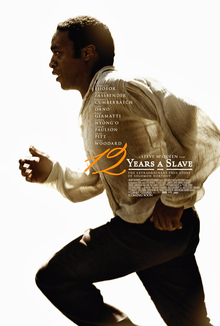
12 Years A Slave

Anybody who has ever paid attention in history class has an idea as to what slavery was like. Quentin Tarantino recently painted a colorful and vivid picture with Django Unchained. However, 12 Years A Slave is more than willing to do the same thing and not wrap it up with a pretty pink vengeful bow. While it's always fun to see some of history's most despicable villains get what's coming to them, that was not the case for Solomon Northup.

Steve McQueen's latest covers the basics - whippings, racial slurs, cotton-picking, and tragedy. Even if it seems all too familiar, the film really lets the emotional and mental abuse of slavery be known. A mother is separated from her two children, just as Solomon was, and she cries for an extended period of time. To some, including Solomon himself, it gets tiresome and aggravating to hear as she wails for all to hear, but it is a feeling that few can imagine, and the idea of it is portrayed effectively. Nearly every bit of the film conveys an aspect of slavery that stays true to the tone and nature of slavery without skimping on the details.

Every character fits the proper role of every kind of person involved in slavery. Chiwetel Ejiofor plays Solomon so well as the man who has everything and then nothing. It's equal parts heartbreaking and remarkable. Michael Fassbender and Sarah Paulson are the relentlessly vile and cruel slave-owning Epps couple that inflict the most torture upon Solomon and the slaves, while Benedict Cumberbatch (yeah, that guy again) portrays the kindly slave owner that is not frequently seen. He still drops the n-bomb as was customary, yet it is nice to see someone who is compassionate toward Solomon. Even the briefly seen actors like Paul Giamatti and Alfre Woodard bring their A-game to the film with memorable parts.

One thing that is a bit of a headscratcher is that the passage of time in the film seems to go by quickly. It doesn't actually feel like twelve years pass for Solomon. Although, in that time, it shows how the effects of his tribulations take a toll on his mental state by the end of the film. Still, it would have probably worked a lot better if it took it's time to flesh it out further.

McQueen's meticulously-crafted drama doesn't hold back on the brutality of one of America's most unpleasant eras. It is haunting, yet poignant, and it's cast is just as powerful in their presentation of every major player in that time.

Monday, November 11, 2013

Thor: The Dark World

On paper, evil alien elves in spaceships vs. space vikings with lasers might sound like one of the coolest things ever, yet on screen, it looks like a deleted Star Trek sequence. Unfortunately, that is what a lot of Thor: The Dark World feels like. Unoriginal, unimaginative, and unnecessary. And honestly, it's sort of disappointing.

After The Avengers, Tony Stark carried on in Iron Man 3 with severe PTSD and a threat to those closest to him. Tony, while still being that same "genius billionaire playboy philanthropist" everybody knows and loves, developed over time, and there was a lot more at stake than he would have expected. People wrote the film off as garbage because of how a beloved villain was handled. Well, you know what? That film handled everything else infinitely better than Thor does here. He's still a charming, yet arrogant super-god that lives in the dazzling realm of Asgard while still pining for his dull and one-dimensional Earth girlfriend Jane Foster. Suddenly, a Saturday morning cartoon villain named Malekith emerges to take control of a force to plunge the universe into eternal darkness. And then, pretty much every scene from other blockbusters (death of a loved one, god-awful comic relief characters, awkwardly-handled action scenes, etc.) begins to unfold.

So, if you couldn't tell by now, Thor isn't the most interesting Avenger. Tony Stark is a smarmy rich guy with inner demons, Steve Rogers is a true patriot stricken with culture shock, and Bruce Banner is unable to escape the monster he created for himself. What does Thor do? He's got a powerful hammer...and some other super-god friends who are so much cooler...and he's got a lady on Earth who knows a thing or two about astrophysics and not much else...and people love him for that. Really, as cliche as it is to say, Loki remains the one true really cool thing about this franchise. Although he went into the whole power-hungry madman mode in The Avengers, there are shades of the tragic villain seen in the previous Thor film that made him somewhat accessible. He has his shot at redemption or the chance to totally betray Thor. What does he choose? Well, it'd probably be unfair to spoil it, but it would be less fair to suggest that you pay to see what happens.

Thor should be entertaining and improved on the first film, but it is nothing more than a cut-and-paste rehash of other superior films with totally boring characters (save for Loki) and a bunch of stupid jokes that no sane human being should find funny. Watching Thor return in the Avengers sequel is gonna be like that awkward reunion with that relative you don't really wanna see but is there anyway, and even though you want them to go away, everybody else wants them there, so you're forced to sit there and sulk.

Sunday, November 3, 2013

The Counselor

If you take a look at this poster and the trailers for The Counselor, you may notice that it is heavily reliant on three (or probably seven) individuals - the five main cast members, director Ridley Scott, and writer Cormac McCarthy delivering his first screenplay. And that's pretty much all the film has to offer. It never reveals anything, never develops properly, and most of all, never gives us a reason to care.

The lawyer only identified as "Counselor" is thrust into the dark and seedy world of drug trafficking through his association with shady characters like Javier Bardem's philosophical Reiner and Brad Pitt's Westray. Scott and McCarthy become more interested in seeing how intellectual and thought-provoking these men can be through their ominous and detailed accounts of the business they're in, yet it is hardly ever done to advance this narrative so much as it is to try and be as self-indulgent as possible. Perhaps, in the back of their minds, they wanted to show how someone like the Counselor could go from being one particular man to another after stepping into the bad business, but they fail to even allow for a connection to the character.

A heavy amount of focus falls on Cameron Diaz as the obviously sinister Malkina (presumably McCarthy's dim-witted attempt at an "exotic" name), who is actually somewhat of an interesting character, until it's clear she's there mostly for fanservice and moderate closure. Diaz doesn't get to do as much with this kind of character as one would hope, and no amount of car sex (that is to say, actual sex with a car) can fix that. The other major female, Penelope Cruz's Laura, is mostly in the distance as everything unfolds. Additionally, the other two women who have more than 10 seconds of screentime are a prison inmate and a pawn used to seduce Westray. McCarthy clearly has some kind of issue with women, making it clear from the get-go as Reiner expresses his distrust and fear of Malkina to the Counselor. Still, you would think McCarthy, having been married twice, would at least know more about a woman than to use them as cookie cutter characters.

The whole film is basically one giant missed opportunity. There appeared to be room for more to play out, but instead, Scott and McCarthy only serve to remind others that the people you think you know are backstabbers and liars, and they do this through an endless array of smarmy dialogue. In short, The Counselor is almost literally a perfect example of all talk and no action.